Car Accident Seat Belt Injuries: Types, Symptoms & What To Do
Seat belts save lives — that’s a fact backed by decades of data. According to the National Highway Traffic Safety Administration (NHTSA), seat belts save an average of 15,000 lives every year in the United States, and wearing one correctly reduces the risk of fatal injury by up to 45%. But here’s the reality that most people don’t talk about: even when a seat belt works exactly as designed, it can still cause serious injuries during a violent car accident. If you or someone you love is dealing with car accident seat belt injuries, understanding what they are, how to recognize them, and what steps to take next could make a critical difference in your recovery — and your legal rights.
Table of Contents
What Are Car Accident Seat Belt Injuries?
Car accident seat belt injuries — often grouped under the medical term “seat belt syndrome” — refer to a specific pattern of injuries caused by the restraining force of a seat belt during a crash. When a collision happens, your body is thrown forward at high speed while the belt holds you back. That sudden, extreme force can damage soft tissue, bones, and internal organs along the path where the belt crosses your body.
These injuries range from mild bruising to life-threatening internal damage. What makes them especially dangerous is that many have delayed symptoms — you may feel fine immediately after the crash, only to discover a serious injury hours or even days later. This is why medical evaluation after any car accident is critical, regardless of how you feel at the scene.
Key fact: Research published on NCBI shows that visible seat belt marks on the skin — called “seat belt signs” — are associated with internal injuries in up to 30% of ER cases involving car accident victims.
Most Common Types of Car Accident Seat Belt Injuries
| Injury Type | Area Affected | Severity Level | Delayed Symptoms? |
|---|---|---|---|
| Seat Belt Sign / Bruising | Chest, abdomen, shoulder | Mild to severe | Sometimes |
| Rib Fractures | Chest | Moderate to severe | No — immediate pain |
| Sternum Fracture | Chest / breastbone | Moderate to severe | No — immediate pain |
| Internal Organ Damage | Abdomen (intestines, kidneys, spleen) | Severe to life-threatening | Yes — very common |
| Spinal Fractures (Chance Fracture) | Lumbar / thoracic spine | Severe | Sometimes |
| Soft Tissue Injuries / Whiplash | Neck, shoulders, back | Mild to moderate | Yes — common |
| Abdominal Wall Tears | Lower abdomen | Moderate to severe | Yes |
| Internal Bleeding | Chest or abdomen | Life-threatening | Yes — very dangerous |
1. Seat Belt Bruising and Abrasions (The “Seat Belt Sign”)
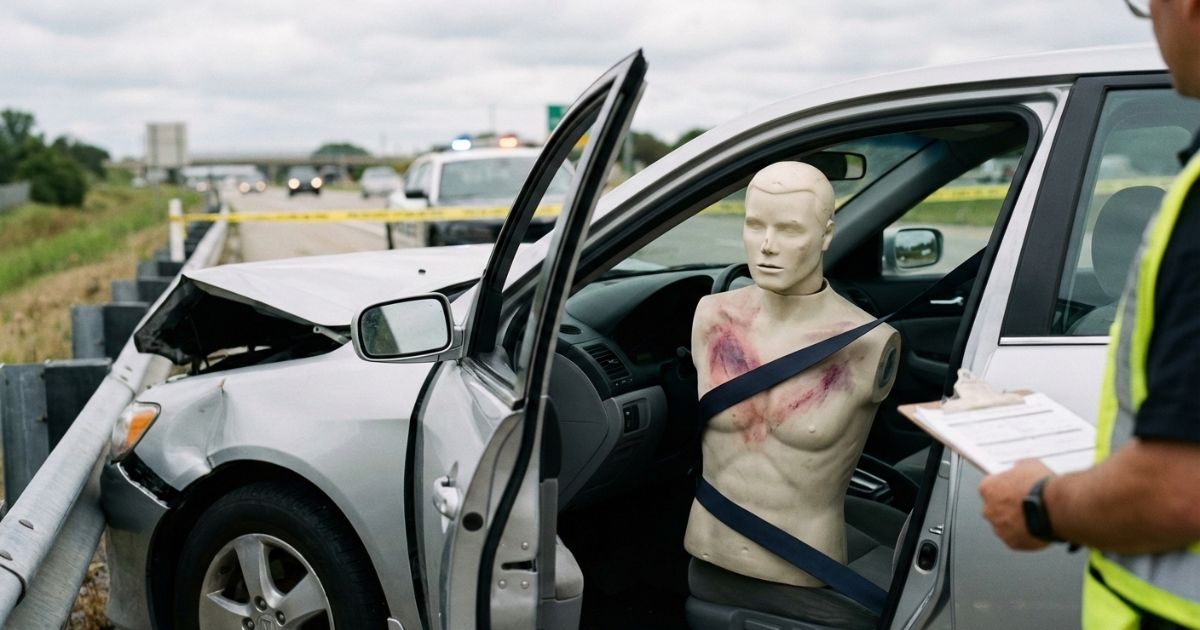
The most visible sign of seat belt injury is bruising or abrasions along the path of the belt — typically a horizontal mark across the abdomen and a diagonal mark running from hip to opposite shoulder across the chest. Emergency room doctors and paramedics are specifically trained to look for this pattern because it is a strong indicator of deeper, more serious injury. If you see this bruising after an accident, go to the ER immediately — don’t wait to see if it gets worse.
2. Rib and Sternum Fractures
The shoulder strap of a seat belt crosses directly over the chest. In a high-speed collision, the force transmitted through the belt can fracture one or more ribs or crack the sternum (breastbone). Rib fractures are painful and can make breathing difficult. In severe cases, broken ribs can puncture a lung, causing a pneumothorax (collapsed lung) — a medical emergency requiring immediate treatment.
3. Internal Organ Damage
This is one of the most dangerous types of seat belt injury because it frequently presents with delayed symptoms. The lap portion of the seat belt sits across the lower abdomen — an area with no rib protection. During a crash, the belt can compress and tear organs including the small intestine, large intestine, kidneys, bladder, stomach, and spleen. According to medical research, intestinal perforations from seat belt injuries are especially dangerous because they may be too small to detect on a CT scan initially, but can become life-threatening within hours if left untreated.
Warning signs of internal organ damage to watch for after a crash:
- Stomach pain or tenderness that worsens over time
- Abdominal swelling or rigidity
- Nausea, vomiting, or diarrhea
- Blood in urine
- Dizziness or lightheadedness
- Shoulder pain (can indicate internal bleeding near the diaphragm)
4. Spinal Fractures — The “Chance Fracture”
A Chance fracture is a specific type of spinal fracture directly linked to seat belt use in car accidents. It occurs when the lap belt acts as a pivot point during a crash, causing the upper body to bend violently forward while the lower body is held in place. This can fracture one or more vertebrae in the lumbar or thoracic spine. In severe cases, it can cause spinal cord damage and partial or full paralysis. This type of injury is more common in rear-seat passengers and in older vehicles without properly positioned three-point belts.
5. Soft Tissue Injuries and Whiplash
Even in lower-speed collisions, the restraining action of a seat belt combined with the sudden motion of a crash can cause significant soft tissue damage to the neck, shoulders, and upper back. Whiplash — a rapid back-and-forth movement of the neck — is one of the most common car accident injuries overall, and seat belt use does not prevent it. Soft tissue injuries often have delayed symptoms, appearing as stiffness or pain 24 to 48 hours after the crash.
6. Internal Bleeding
Internal bleeding is the most immediately life-threatening seat belt injury. It can result from damage to any internal organ or blood vessel. The dangerous part is that internal bleeding often has very few outward symptoms in the early stages, yet it can become fatal within hours. If you have a visible seat belt bruise after a crash, you should treat it as a potential emergency and seek immediate medical evaluation.
Symptoms of Seat Belt Injuries: What to Watch For
Because many seat belt injuries have delayed symptoms, knowing what to look for in the hours and days after a crash is critical. Do not assume you are fine just because you feel okay immediately after the accident.
Seek emergency care immediately if you experience:
- Visible seat belt bruising or abrasions on chest, abdomen, or shoulder
- Sharp or worsening abdominal pain
- Chest pain or difficulty breathing
- Back pain or numbness/tingling in arms or legs
- Swelling in the abdomen
- Dizziness, confusion, or fainting
- Blood in urine or stool
- Shoulder pain with no direct impact to the shoulder
See a doctor within 24–48 hours if you experience:
- Neck stiffness or soreness
- Mild to moderate back pain
- Tenderness along the seat belt line without visible bruising
- General fatigue or malaise after the accident
How Are Seat Belt Injuries Diagnosed?
Diagnosing seat belt injuries requires a combination of physical examination and imaging. When you arrive at the ER or doctor’s office after a car accident, tell them you were wearing a seat belt and show them any visible marks. The diagnostic process typically includes:
Physical examination: Doctors look specifically for seat belt signs — bruising, abrasions, or tenderness along the belt path. Research shows that people with visible seat belt marks are 4 to 8 times more likely to have suffered chest and abdominal injuries.
CT scan: A computed tomography scan of the chest and abdomen is the standard imaging tool for assessing internal injuries from car accidents. However, some small bowel perforations may not show up immediately.
X-rays: Used to identify rib fractures, sternum injuries, and spinal fractures.
FAST ultrasound: Focused Assessment with Sonography in Trauma — a rapid ultrasound used in ERs to check for free fluid in the abdominal cavity, which can indicate internal bleeding.
Laparotomy: In some cases, abdominal surgery is necessary to identify and treat internal organ injuries that cannot be detected through imaging.
Recovery Time for Seat Belt Injuries
Recovery time depends entirely on the severity of the injury. According to medical experts:
| Injury | Typical Recovery Time |
|---|---|
| Bruising and surface abrasions | Days to 2–3 weeks |
| Soft tissue injuries / whiplash | Weeks to 3 months |
| Rib fractures | 6–8 weeks |
| Sternum fracture | 8–12 weeks |
| Internal organ damage (surgical) | Several months |
| Spinal fracture | Months to over a year (varies greatly) |
| Internal bleeding (treated promptly) | Weeks to months |
Chronic pain is a real possibility with more serious seat belt injuries, particularly spinal fractures and significant internal organ damage. Long-term physical therapy, pain management, and sometimes additional surgeries may be required.
What To Do After a Car Accident Seat Belt Injury
The steps you take in the hours and days after a car accident are critical — both for your health and for protecting your legal rights.
Step 1 — Call 911 immediately. Even if you feel fine, request both police and an ambulance. A police report documents the accident officially, and paramedics can begin assessing for injuries at the scene.
Step 2 — Do not refuse medical treatment at the scene. Refusing treatment or transport to the hospital can be used against you later if you file an injury claim. Paramedics may detect early signs of internal injury that you cannot feel yet.
Step 3 — Go to the ER or urgent care within 24 hours. If you did not go by ambulance, get evaluated by a doctor as soon as possible. Tell them you were in a car accident and were wearing a seat belt. Show them any bruising or marks.
Step 4 — Document everything. Take photos of your bruising, abrasions, and any visible seat belt marks immediately — and again over the following days as bruising often develops and worsens. Keep records of all medical visits, diagnoses, treatments, and costs.
Step 5 — Exchange information. Get the other driver’s name, contact information, insurance details, and license plate number. Get contact information from any witnesses.
Step 6 — Notify your insurance company. Report the accident to your insurer promptly. Be factual and do not speculate about fault or minimize your injuries.
Step 7 — Consult a personal injury attorney. If your injuries are the result of another driver’s negligence, you may be entitled to compensation for medical bills, lost wages, and pain and suffering. Most personal injury attorneys offer free consultations. In most states, you have a limited time window (statute of limitations) to file a claim — typically 2 to 3 years from the accident date, but this varies by state.
Does Wearing a Seat Belt Affect an Injury Claim?
This is a question many accident victims have — and it is an important one. In most U.S. states, wearing a seat belt is both legally required and beneficial to your injury claim. If you were properly wearing your seat belt at the time of the accident, it demonstrates responsible behavior and does not reduce your ability to recover compensation.
In a small number of states, a “seat belt defense” exists, allowing the at-fault driver’s insurance to argue that your injuries were worsened by not wearing a belt — which could reduce your compensation. This varies significantly by state, which is another reason to consult a local personal injury attorney if you’ve been injured.
Key point: According to 2024 NHTSA data, seat belt use in the U.S. stands at 91.2% — yet unrestrained occupants still account for nearly 49.2% of all passenger vehicle occupant deaths. This data consistently reinforces that wearing a seat belt — even when it causes injuries — is overwhelmingly better than not wearing one.
Seat Belt Injuries in Children and Rear-Seat Passengers
Children and rear-seat passengers face specific risks with seat belt injuries. Improperly fitted belts — where the shoulder strap crosses the child’s neck or face, or the lap belt sits across the soft abdomen rather than the hip bones — significantly increase the risk of serious injury in a crash. Children under 13 should always ride in the rear seat with properly fitted restraints appropriate for their age, height, and weight. All 50 states have child passenger safety laws.
For rear-seat adult passengers, studies show that rear seat belts are 73% better at preventing fatalities in crashes involving vans and SUVs. However, rear-seat passengers are often less likely to buckle up — and they face the same risk of seat belt syndrome injuries as front-seat occupants.
This might interest you : Car Seat Attorneys
Frequently Asked Questions About Car Accident Seat Belt Injuries
Can you sue for seat belt injuries in a car accident?
Yes. If the accident was caused by another driver’s negligence, you can pursue a personal injury claim for all injuries caused — including those caused by the seat belt. The fact that you were wearing your belt as required by law generally works in your favor.
How long after a car accident can seat belt injuries appear?
Some injuries, particularly soft tissue injuries and certain internal injuries, can take 24 to 72 hours or even longer to produce noticeable symptoms. This is why immediate and follow-up medical evaluation after any significant car accident is essential.
What does a seat belt injury feel like?
Immediately after a crash, you may feel soreness, tenderness, or a burning sensation along the belt line. More serious internal injuries may initially feel like general abdominal discomfort, nausea, or fatigue — which is why they are easy to underestimate.
Is seat belt bruising serious?
A seat belt bruise should always be taken seriously. Significant bruising along the belt path indicates that tremendous force was applied to that area, and research shows this is associated with internal injury in up to 30% of cases. Go to the ER if you have visible seat belt bruising.
Can seat belts cause internal bleeding?
Yes. The force of a severe crash transmitted through a seat belt can rupture blood vessels and organs in the abdomen and chest, causing internal bleeding. This is one of the most dangerous seat belt injuries because symptoms can be subtle and delayed while the condition worsens rapidly.
What is seat belt syndrome?
Seat belt syndrome is the medical term for the specific pattern of injuries caused by seat belt use in car accidents. It typically includes abdominal injuries, spinal fractures (Chance fractures), and soft tissue injuries to the chest and abdomen, often associated with visible seat belt marks on the skin.
Conclusion
Car accident seat belt injuries are a reality that millions of crash survivors face every year. While seat belts remain one of the most effective life-saving devices ever invented — preventing nearly 15,000 deaths annually in the U.S. — the force they exert during a crash can cause serious injuries ranging from surface bruising to life-threatening internal damage. The key to protecting yourself is knowing the signs, seeking immediate medical attention even when you feel okay, documenting everything carefully, and understanding your legal rights.
If you’ve been injured in a car accident, do not minimize your symptoms and do not delay medical care. The seat belt marks on your skin may be telling you something important that you cannot yet feel.