Best Car Adverts of All Time: The Most Iconic Automotive Ads Ever Made
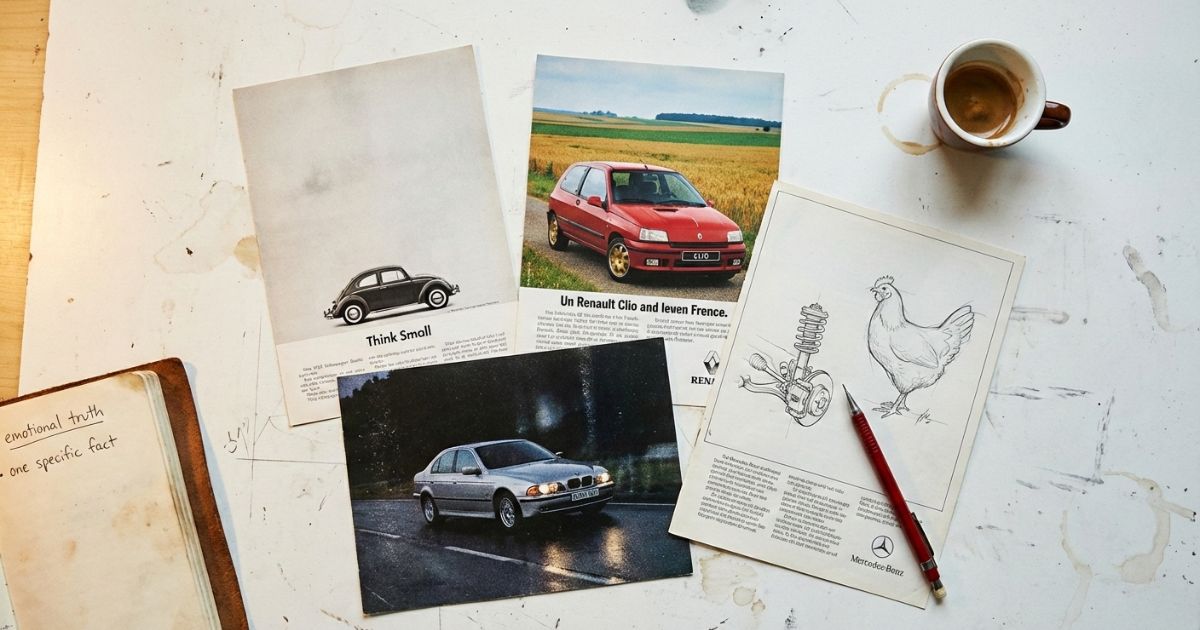
Car advertising is unlike any other category. No other industry has the budget, the emotion, the aspiration, and the raw mechanical drama to produce what the best automotive ads consistently deliver — miniature films that outlive the cars they were made to sell and change the way entire industries think about marketing. From a single black-and-white print ad in 1959 that rewrote the rules of luxury advertising, to a Belgian action star straddling two reversing trucks to the sound of Enya in 2013, car adverts have produced some of the most inventive, emotional, and technically spectacular creative work in the history of advertising. We analyzed rankings and critical assessments from Top Gear, Hagerty, Creative Bloq, HotCars, The Gentleman’s Journal, and 42Courses to bring you the definitive guide to the best car adverts ever made — ranked by creative impact, cultural resonance, and the stories behind them.
Table of Contents
What separates a great car advert from a forgettable one: The best car ads do not sell a car. They sell a feeling, an identity, or an idea — and the car becomes the vehicle for something much bigger. The greatest examples on this list have one thing in common: they understood their audience’s desires more deeply than their audience understood themselves.
What Makes a Car Advert Truly Great?
Car brands spend around $40 billion globally on advertising every year. Most of it produces work that is competent but forgettable. The adverts on this list endure because they achieved something measurably different — they changed behavior, shifted brand perception, won cultural arguments, or simply created moments so unexpected that audiences could not stop talking about them.
The best car adverts succeed on three levels simultaneously. They communicate a clear product truth — something real and specific about what the car can do or what it represents. They do it through a creative device that is genuinely surprising — not just expensive or celebrity-driven, but conceptually original. And they leave the viewer with an emotional residue — a feeling about the brand that persists long after the specific details of the ad have faded.
The 20 Best Car Adverts of All Time — Full Rankings
| Rank | Advert | Brand | Year | Why It’s Iconic |
|---|---|---|---|---|
| 1 | “Think Small” | Volkswagen Beetle | 1959 | Changed the entire language of advertising — not just car ads |
| 2 | “The Cog” | Honda Accord | 2003 | £1 million, 606 takes, 4 days — won every advertising award imaginable |
| 3 | Rolls-Royce “At 60 mph” | Rolls-Royce Silver Cloud | 1959 | David Ogilvy’s masterwork — the greatest single headline in advertising history |
| 4 | JCVD Epic Split | Volvo Trucks | 2013 | 126 million views — barely an advert, entirely a cultural event |
| 5 | “Changes” / Paula Hamilton | Volkswagen Golf | 1987 | Pivotal moment for women in advertising — ranked #42 greatest TV ad ever |
| 6 | Nicole & Papa | Renault Clio | 1991–1998 | Invented episodic car advertising — “Papa? Nicole!” entered British cultural vocabulary |
| 7 | BMW Films “The Hire” | BMW | 2001–2002 | Invented branded content — 8 films, Guy Ritchie, Ang Lee, Clive Owen |
| 8 | “The Force” (Darth Vader Kid) | VW Passat | 2011 | Most shared Super Bowl ad in history at the time of release |
| 9 | Nissan GT-R “Swings” | Nissan GT-R | 1990 | Directed by Ridley Scott — “Fastest saloon on the planet” is one of advertising’s greatest mic drops |
| 10 | Mercedes Magic Body Control Chicken | Mercedes-Benz | 2013 | A chicken’s head demonstrates suspension technology — pure creative genius |
| 11 | Jaguar “British Villains” | Jaguar F-Type | 2014 | Super Bowl debut — Kingsley, Hiddleston, and Strong reframe British cool |
| 12 | Audi Godfather Spoof | Audi R8 | 2008 | Super Bowl — front bumper in the bed instead of a horse’s head. Perfect. |
| 13 | Skoda “Fabia — Baked” | Skoda Fabia | 2007 | Car built entirely from food — turned a derided brand into a beloved one |
| 14 | BMW Martini Glass Print | BMW 6-cylinder | 1980s | A Martini glass on a BMW engine vs. a Mercedes — perfect proof without words |
| 15 | Dodge Challenger “Predator” | Dodge Challenger | 2009 | Phil Collins’ “In the Air Tonight” + muscle car mythology = perfection |
| 16 | VW Beetle “History” (2024) | Volkswagen | 2024 | 75 years of American VW history in 60 seconds — Neil Diamond soundtrack |
| 17 | Porsche 911 “Boy” | Porsche 911 | 2001 | A young boy’s first sight of a 911 — the most honest car ad ever made |
| 18 | VW Golf Mk2 Casino | Volkswagen Golf GTI | 1980s | Absolute dependability — VW at its most quietly confident |
| 19 | Audi vs. Mercedes “Prison Break” | Audi A8 | Super Bowl 2012 | Old luxury vs. new luxury — nailed the brand positioning argument in 60 seconds |
| 20 | Hyundai Ioniq 6 ft. Kevin Bacon | Hyundai Ioniq 6 | 2023 | Kevin Bacon + his daughter Sosie — the freshest EV ad in a sea of boring ones |
Deep Dive: The Stories Behind the Greatest Car Adverts Ever Made
1. Volkswagen Beetle — “Think Small” (1959) — The Ad That Changed Everything
There is before “Think Small” and there is after it. In 1959, American advertising was defined by aspiration, scale, and exaggeration — bigger cars, bigger promises, bigger type. The Beetle was a tiny, ugly, German car trying to sell in a market that had just watched Hitler drive around in one. The brief was effectively impossible.
One of the most influential ads ever made — not just in terms of car sales — VW’s “Think Small” campaign changed how cars were marketed entirely. Shifting the focus from the typical “look at how wonderful this car is” style of advertising, VW went the self-deprecating route to sell the Beetle in North America.
The ad placed a tiny image of the Beetle in the top left corner of a vast white page, with the headline “Think Small” — directly mocking every advertising convention of its era. The body copy was honest, self-deprecating, and conversational in a way that had never been seen in mainstream print advertising. It did not just sell cars. It created a cultural movement around the idea that small, honest, and reliable was something to be proud of rather than ashamed of. Agencies still study it today as the single most transformative print advertisement ever created.
2. Honda Accord — “The Cog” (2003) — The Most Technically Ambitious Car Ad Ever Made
Premiering in the 2003 Brazilian Grand Prix advert break, it cost £1,000,000, took 606 takes over 4 days of filming. The ad — nicknamed “The Cog” in advertising circles — formed a Rube Goldberg machine out of a fully disassembled Honda Accord, with each component triggering the next in a perfectly choreographed two-minute sequence. It won the grand prize at the British Television Advertising Awards. While car ads tend to focus on the image a car gives off, “The Cog” focused on the mechanical side of the story.
The creative genius of “The Cog” is that it used the complexity of its execution to communicate the complexity of Honda’s engineering — every component working in perfect harmony was a metaphor for every Honda vehicle. It is the only car advert that is genuinely more impressive the more you understand about how hard it was to make.
3. Rolls-Royce Silver Cloud — “At 60 mph” (1959) — The Greatest Headline in Advertising History
Throughout the first half of the twentieth century, Rolls-Royce’s adverts tended to follow a similar pattern — stuffy. They quite often featured a large image, normally an artwork, showing a Rolls-Royce model parked in front of a stately home, under the headline ‘The best car in the world’. That was until 1959 when a man called David Ogilvy ripped up that formula and created one of the greatest car adverts of all time.
Ogilvy’s headline — “At 60 miles an hour the loudest noise in this new Rolls-Royce comes from the electric clock” — is the most studied piece of copywriting in the history of advertising. It proved a specific, verifiable engineering fact in the most vivid possible way, and it did it without a single superlative or marketing cliché. It transformed the way luxury goods were advertised globally. Ogilvy himself said he spent three weeks reading about the car before writing a single word.
4. Volvo Trucks — “Epic Split” feat. Jean-Claude Van Damme (2013) — The Most Watched Truck Ad in History
Nope, it’s not CGI. That really, actually is Jean-Claude Van Damme straddling two reversing Volvo lorries. In a box split. To Enya. It can barely be described as an advert — the exact point of it is so unclear that it has to actually be explained in writing at the end — it’s simply a strange, wonderful little piece of art designed to create a viral moment. 126 million views later, we’d say it succeeded.
The ad was made to demonstrate Volvo’s dynamic steering technology for trucks — a feature so specific and technical that no conventional ad could have made it interesting. The solution was to not try to explain the technology at all, but to demonstrate the precision it enabled through the most absurd, spectacular, and physically demanding stunt imaginable. Van Damme needed only one take.
5. Volkswagen Golf — “Changes” feat. Paula Hamilton (1987) — When Car Advertising Found Women
The VW Golf “Changes” ad is today remembered as a pivotal moment in car advertising’s recognition of women as independent voices. Previous ads had only either featured women as models or shown them as passengers. In April 2000, it was ranked at number 42 on Channel 4’s The 100 Greatest TV Ads, where it was described as being “a sign that feminism had at last reached the ad men.”
The ad shows Paula Hamilton’s character leaving her husband, shedding every material possession — fur coat, pearls, wedding ring — but keeping her VW Golf keys. The tagline “If only everything in life was as reliable as a Volkswagen” turned a car’s mechanical dependability into a statement about independence and self-determination. It was one of the first mainstream car ads to treat a woman as the decision-maker rather than the passenger.
6. Renault Clio — Nicole & Papa (1991–1998) — The Ad That Invented Episodic Car Advertising
Created by Publicis, this sweet campaign for the Renault Clio achieved iconic status in 1990s Britain through its simple yet captivating narrative. Focusing on the relationship between a young woman and her father, these ads unveiled an enigmatic storyline where Nicole frequently slipped away to meet her boyfriend. At the campaign’s core was its simple, recurring dialogue — “Papa?” “Nicole!” — which became instantly recognisable across the UK.
The Nicole and Papa campaign ran for seven years and produced some of the most anticipated television events of the 1990s in Britain — viewers genuinely waited for the next installment. It was the first car advertising campaign to treat its audience as followers of an ongoing narrative rather than recipients of product messages. The format it invented — episodic character-driven automotive storytelling — is still being copied thirty years later.
7. BMW Films — “The Hire” (2001–2002) — The Ad That Invented Branded Content
BMW revolutionised the advertising world with a series of eight short films directed by top-notch filmmakers like Guy Ritchie, John Frankenheimer, Tony Scott and Ang Lee. Starring Clive Owen as ‘The Driver,’ each film showcased the performance and design of BMW cars in thrilling storylines.
“The Hire” was made before YouTube existed — BMW distributed it online at a time when streaming video was a novelty, and the films attracted over 100 million views in an era when that number was almost incomprehensible for non-broadcast content. It did not just promote the cars — it created genuine entertainment that people sought out. Every brand content strategy created since 2001 traces its lineage to “The Hire.”
8. Volkswagen Passat — “The Force” (Super Bowl 2011) — The Most Shared Super Bowl Ad of Its Era
A small child in a Darth Vader costume tries to use the Force on household objects — including the family Passat — with no success, until Dad remotely starts the car from the kitchen window, convincing the child the Force actually worked. In 2011, the agency Deutsch knocked it out of the park with its ‘The Force’ spot for the VW Passat. A cute kid wearing a Darth Vader costume. What more do you need?
The ad communicated the Passat’s remote start feature without ever technically describing it. It was the most shared Super Bowl ad in history at the time of its release, and it proved something that the advertising industry has been trying to replicate ever since: a simple, human, emotional story almost always outperforms a technically detailed product demonstration.
9. Nissan GT-R — “Swings” (1990) — Ridley Scott’s Automotive Masterpiece
This ad was made back in 1990 to promote Nissan’s fastest model. If it has the filmic quality of a Hollywood blockbuster, that’s no surprise as it was directed by none other than Ridley Scott, who is the same guy behind the movies Alien, Blade Runner, Thelma & Louise, and Gladiator.
The big reveal, followed by the “fastest saloon on the planet” slogan has to be one of the heaviest mic drops in advertising history. One of the coolest ever car ads, for one of the coolest ever cars. Scott brought the same visual language he used in Blade Runner to automotive advertising — atmospheric, cinematic, and genuinely menacing. It set the visual standard for performance car advertising that is still referenced in briefs today.
10. Mercedes-Benz — “Magic Body Control Chicken” (2013) — The Cleverest Product Demonstration Ever Made
Mercedes needed to explain a suspension system so sophisticated it kept the car body perfectly stable regardless of road surface. They could have shown the car travelling serenely over bumpy and broken tarmac to demonstrate the groundbreaking technology, but instead, they chose a chicken. You’ll never look at this flightless bird in the same way again.
The ad showed chickens — whose heads remain perfectly stable regardless of body movement — dancing to Diana Ross’s “Upside Down.” The insight that a chicken’s head stabilization system is a perfect natural analogy for Mercedes’ suspension technology is so simple and so right that it feels inevitable in hindsight. It is not. It is the result of a creative leap that most advertising agencies could attempt for years without achieving.
The Most Creative Eras in Car Advertising History
| Era | Defining Approach | Landmark Work | Why It Mattered |
|---|---|---|---|
| 1930s–1940s | Art Deco illustration and exclusivity | Cadillac Art Deco print ads | First to use car advertising as a statement of social aspiration |
| 1950s–1960s | Wit and self-deprecation vs. aspiration | VW “Think Small,” Rolls-Royce “At 60 mph” | Established the two great competing philosophies of car advertising |
| 1970s–1980s | Product truth told with specificity | BMW Martini Glass print, VW Golf “Changes” | Proof-point advertising — specific claims over general boasting |
| 1990s | Episodic storytelling and character | Renault Clio Nicole & Papa, VW “Small but Tough” | Invented the idea of car advertising as ongoing narrative |
| 2000s | Technical spectacle and branded content | Honda “The Cog,” BMW Films “The Hire” | Set the benchmark for production ambition and digital distribution |
| 2010s | Viral stunts and emotional storytelling | Volvo JCVD Epic Split, VW “The Force” | Proved that sharing IS the media strategy |
| 2020s | Heritage, celebrity, and EV repositioning | VW Beetle History (2024), Hyundai Ioniq 6 Kevin Bacon | Brands navigating identity in the electric transition |
The Best Car Adverts by Brand — Who Does It Best?
Volkswagen — The Greatest Car Advertising Brand in History
No other car brand has produced as many transformative advertising moments across as many decades as Volkswagen. From “Think Small” in 1959 through the Golf “Changes” in 1987, the Polo “Small but Tough” campaign of the 2000s, “The Force” in 2011, and the emotional VW history spot in 2024 — Volkswagen’s advertising philosophy has remained remarkably consistent across 65 years: honest, self-aware, human, and specific. VW is regarded as the maestro of car advertising for good reason — no other brand has used the same core philosophy across multiple eras and multiple agencies with such consistent excellence.
Honda — The Most Technically Ambitious Car Advertising
Honda’s advertising reputation rests primarily on one monument — “The Cog” — but the philosophy behind it runs through the brand’s entire advertising history. Honda’s creative work consistently focuses on the engineering truth inside the car, not the lifestyle around it. The result is advertising that treats the audience as intelligent and rewards attention. “The Cog” is its most spectacular expression, but the same philosophy produced a series of technically ambitious campaigns across two decades that no other mass-market manufacturer matched.
BMW — The Brand That Invented a New Medium
BMW’s “The Hire” film series did not just produce eight great car adverts — it invented branded content as a media format. By hiring directors of the caliber of Guy Ritchie, Ang Lee, and Tony Scott to make genuine short films featuring BMW cars, the brand created work that audiences actively sought out rather than passively received. BMW’s advertising consistently positions its cars as the intelligent choice for people who understand the difference between transportation and driving.
Jaguar — The Most Dramatically Reinvented Brand in Advertising
Few brand advertising transformations are as dramatic as Jaguar’s. For decades, Jaguar advertising was conservative, heritage-focused, and aimed at older buyers. The 2014 Super Bowl “British Villains” campaign — featuring Ben Kingsley, Tom Hiddleston, and Mark Strong explaining why British actors make such perfect Hollywood villains — repositioned the entire brand in 60 seconds. Directed by famed director Tom Hooper, this commercial put Jaguar back on the map.
Volvo — The Masters of Stunt-Based Advertising
Volvo’s advertising history is defined by its willingness to demonstrate engineering claims through physical stunts rather than technical explanations. The Jean-Claude Van Damme Epic Split is the ultimate expression of this philosophy — demonstrating precision steering technology by having the world’s most famous martial artist perform a full splits between two moving trucks. It is the purest possible example of showing rather than telling.
The Best Recent Car Adverts (2020–2025)
Car advertising in the 2020s faces a challenge earlier generations never encountered: how do you sell electric vehicles — defined by what they do NOT do (no engine noise, no exhaust, no gear changes) — using the emotional and sensory language that made car advertising great? The best recent work has found creative solutions.
The VW Beetle History ad from 2024 takes you on a trip through the brand’s history in the US, soundtracked by Neil Diamond’s 1971 song “I Am… I Said.” Although the video is only 60 seconds long, you feel like you’ve traversed several generations of Americans — and there always was a Volkswagen there. Starting with the Beetle’s arrival in America in 1949 and ending with the latest VW ID. Buzz electric van, it is one of the most emotionally complete 60-second pieces of brand storytelling in automotive advertising history.
The Hyundai Ioniq 6 campaign featuring Kevin Bacon and his daughter Sosie managed to make an EV feel warm and human rather than technological and cold — a rare achievement in electric vehicle marketing, where most advertising defaults to technical specification lists and CGI driving sequences that communicate nothing about the ownership experience.
What the Greatest Car Adverts Have in Common
Studying the 20 adverts on this list reveals patterns that define what separates automotive advertising excellence from expensive mediocrity.
The best car ads are about people, not cars. “The Force” is about a child’s imagination. “Changes” is about a woman’s independence. Nicole and Papa is about a father-daughter relationship. The car is the device through which the human story is told — never the subject of the story itself.
The best car ads find one specific truth and commit to it completely. “At 60 mph the loudest noise is the electric clock” is not a general claim about Rolls-Royce quality. It is one specific, verifiable, utterly surprising fact that makes the general quality claim unnecessary. The Martini glass on a BMW engine is not a claim about smoothness — it is a demonstration so precise it requires no interpretation.
The best car ads do something unexpected with their medium. “The Cog” used the materials of its own product to create its spectacle. “The Hire” turned advertising into cinema. The Epic Split turned a truck safety technology demonstration into a work of performance art. Each found a way to use its format that had never been seen before.
The best car ads create a cultural moment, not just a commercial. People did not just watch the Epic Split — they talked about it, shared it, and debated whether it was CGI. People did not just see “The Force” — they showed it to their children. The greatest car adverts become part of the cultural conversation around them rather than simply interrupting it.
This might interest you : Best Car Radio Head Units in 2026: Top Picks for Every Budget & Car
Conclusion
The greatest car adverts are not the most expensive, the most celebrity-filled, or the most technically spectacular. They are the ones that found a specific truth about a specific car and expressed it through a creative device so surprising, so human, or so technically brilliant that it became impossible to forget. Volkswagen’s “Think Small” proved that self-deprecation was more persuasive than boasting. Honda’s “The Cog” proved that mechanical complexity could be made beautiful. Volvo’s Epic Split proved that the most unexpected stunt is more effective than the most polished production. And the Nicole and Papa campaign proved that audiences would follow a story across seven years if the characters were compelling enough.
The adverts on this list did more than sell cars. They advanced the craft of advertising itself — introducing formats, philosophies, and techniques that every other industry adopted. That is why, decades after the cars they advertised have left the road, these adverts remain the benchmarks against which all automotive creativity is measured.