Pixel Car Racer Best Tuning Guide 2026: Max Speed, Drag & Street Builds
If you’ve been running the same tired setup and watching faster players gap you off the line, this guide is going to change everything. Pixel Car Racer is not just a game about having the most expensive car — it’s about understanding how tuning, gear ratios, engine selection, and nitrous timing interact to produce the fastest possible run. The difference between a 6.2-second quarter mile and a sub-5.9 is almost never the car itself — it’s the tune. We’ve pulled together the most effective builds and tuning setups from the Pixel Car Racer Wikia, CarThrottle community guides, and top players on the PCR leaderboard to give you the most complete tuning guide available in 2026.
Table of Contents
This guide is your ultimate resource for pixel car racer best tuning, ensuring you maximize your performance on the track.
The single most important tuning principle in Pixel Car Racer: Adjust your gear ratios so your tachometer needle stays inside your engine’s powerband on every shift. Everything else in this guide builds on that one rule.
Understanding the Pixel Car Racer Tuning System
Pixel Car Racer Best Tuning Techniques
Before touching gear ratios or engine upgrades, you need to understand what each tuning parameter actually does in the game — because guessing costs you race time and in-game money.
Engine: Determines your horsepower and torque curve. Different engine types respond differently to upgrades and tuning. The engine is the foundation of every build — choose wrong and no amount of gear tuning will save you.
Gear Ratios: Control how quickly you accelerate through each gear and your top speed. Short gear ratios accelerate faster but hit a lower top speed. Tall gear ratios have slower acceleration but higher top speed. Finding the right balance for your race type — drag vs. street — is the core skill in Pixel Car Racer tuning.
Final Drive: Multiplies the effect of all other gear ratios. A higher final drive number makes all gears shorter — better launch, lower top speed. A lower number makes all gears taller — slower launch, higher top speed. The final drive is the most powerful single adjustment you can make to the entire gear stack.
Suspension: Affects weight transfer on launch and handling through corners. For drag builds, stiffer rear suspension helps transfer weight to the rear wheels for better traction off the line.
Nitrous: Provides a burst of power but must be timed correctly. Using nitrous too early causes wheelspin and wasted boost. Using it at the wrong RPM wastes the power spike. Timing nitrous to hit when you’re already in the powerband is the difference between a clean run and a slow one.
Tires: Determine grip on launch and through the run. Wider tires increase grip but add weight. For drag racing, maximum grip compounds on the rear are essential. For street racing, a balance of grip and handling is required.
Best Engines in Pixel Car Racer — Ranked for Each Build Type
| Engine | Best For | Strengths | Weaknesses | Tier |
|---|---|---|---|---|
| LT5 V8 | Drag racing — current meta | Best power output for drag, excellent torque curve, responds well to full upgrade stack | Expensive, requires full upgrade investment to shine | S-Tier |
| V8 LS1 | All-around drag and street | Best balance of acceleration, torque, and stability — ideal all-rounder | Not the absolute peak for pure drag specialists | S-Tier |
| V12 | Top speed builds, highway racing | Highest horsepower ceiling in the game | Heavy, harder to tune for drag launches | A-Tier |
| 2JZ Inline-6 | Turbo builds, JDM cars (Supra) | Excellent turbo response, high RPM ceiling, great with boost upgrades | Needs significant boost upgrades to compete with V8 | A-Tier |
| RB26 Inline-6 | GTR builds, AWD drag | Strong mid-range torque, excellent with AWD traction advantage | Not as powerful as V8 at peak | A-Tier |
| Rotary (13B) | Lightweight street builds | Ultra-light, high RPM, great for cars where weight matters most | Avoid long drag runs — overheating risk, no low-end torque | B-Tier |
| V6 | Mid-budget builds | Balanced power and control, good for players moving up from I4 | Outclassed by V8 and LT5 at high investment levels | B-Tier |
| I4 Turbo | Budget builds, early game | Affordable, smooth acceleration for beginners | Limited ceiling — outgrown quickly | C-Tier |
Current engine meta note (2025–2026): The LT5 is now the better engine option for drag racing builds, replacing older community recommendations. If you’re following an older guide that recommends a different engine as the top choice — it may be outdated.
Best Gear Ratio Tuning Setups
Gear ratios are where most players either win or lose a race before it even starts. Here are the proven setups for each race type, pulled from top community leaderboard players.
Best Drag Racing Gear Ratios (1/4 Mile Focus)
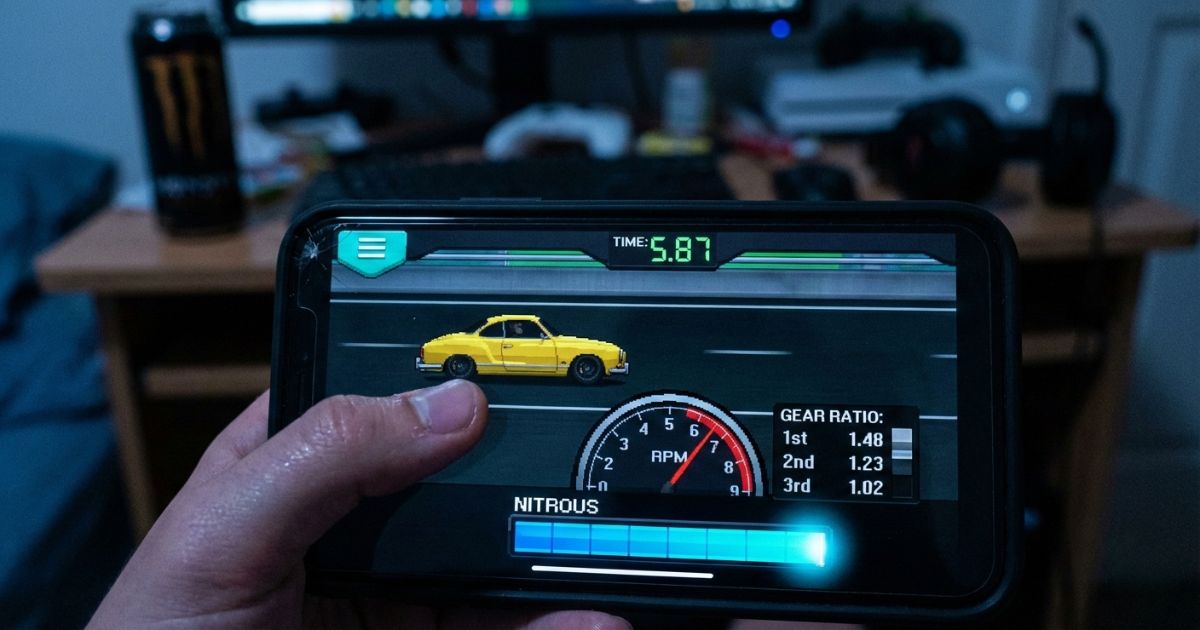
This gear setup works great with rear-wheel-drive cars like the Alpina A101 and Karmann Ghia, with a personal record of 5.878 seconds:
| Gear | Ratio | Purpose |
|---|---|---|
| 1st | 1.48 | Hard launch — keeps RPM in powerband off the line |
| 2nd | 1.23 | Strong early acceleration through first shift |
| 3rd | 1.02 | Maintains momentum through mid-run |
| 4th | 0.90 | Builds toward top end without killing RPM |
| 5th | 0.80 | Top end pull |
| 6th | 0.73 | Final gear for maximum top speed |
| Final Drive | 3.90 | Aggressive short final drive for strong overall acceleration |
Key principle behind this setup: Adjust your gear ratios so your tachometer needle stays always in the powerband of your engine. Watch your tach on test runs — if you’re dropping out of the powerband on any shift, tighten that gear pair. If you’re hitting the limiter too quickly, lengthen it slightly.
Best Street Racing Gear Ratios (Balanced Speed + Acceleration)
Street racing in Pixel Car Racer requires a different philosophy than pure drag. You need usable acceleration across a wider speed range, not just an explosive launch. The recommended approach for street builds is a slightly longer gear stack with a lower final drive ratio — approximately 3.20–3.50 — to carry more speed between shifts without losing too much launch aggression.
| Gear | Ratio | Purpose |
|---|---|---|
| 1st | 2.50–2.80 | Controlled launch — avoids excessive wheelspin on street |
| 2nd | 1.80–2.00 | Smooth second gear pull without abrupt power spike |
| 3rd | 1.40–1.55 | Mid-range punch for overtaking |
| 4th | 1.10–1.20 | Sustained high-speed acceleration |
| 5th | 0.90–1.00 | Highway pull |
| 6th | 0.75–0.85 | Maximum top speed |
| Final Drive | 3.20–3.50 | Balanced — good launch without sacrificing top end |
Best Car Builds for Pixel Car Racer in 2026
Build 1: The Sub-6 Second Drag King — Volkswagen Karmann Ghia
For the best sub-six second car, you need the Volkswagen Karmann Ghia. This car is extremely light and is surprisingly grippy. You could argue by saying the Subaru Rex is the lightest car in the game — and yes it is — but it doesn’t have any grip to get off the line.
The Karmann Ghia is the most celebrated drag build in the Pixel Car Racer community for good reason. Its combination of low weight and rear-wheel-drive grip makes it the ideal platform for a maximum-attack drag tune. It is found in the EU section of the car dealer.
Karmann Ghia Sub-6 Second Build:
Engine: LT5 V8 (fully upgraded — pistons, seats, exhaust, intercooler all at maximum)
Turbo: Diamond Turbo (or highest tier available)
Transmission: Full 6-speed manual with drag-optimized ratios (see table above)
Tires: Maximum grip compound rear, medium front
Suspension: Stiff rear, medium front for weight transfer
Nitrous: Stage 3 — activated between 2nd and 3rd gear shift when RPM is inside powerband
Budget required: approximately 22.7 million in-game dollars. You will need to grind very hard if you aren’t lucky with crates, but the outcome is worth it.
Launch control tip for the Karmann Ghia: Hold brake, rev to approximately 70% of powerband, release brake while feeding throttle progressively. Slamming throttle from zero causes wheelspin that kills your 60-foot time and ruins the entire run.
Build 2: The GTR R35 Tournament Dominator
The Nissan GT-R R35 Nismo is one of the most popular tournament builds in Pixel Car Racer, and the 6-second GTR Nismo tune has been proven at the highest tournament levels. The GTR 35 Nismo is considered one of the best RWD tournament builds in Pixel Car Racer, combining strong engine options with a chassis that handles launch forces well.
GTR R35 Nismo Tournament Build:
Engine: LT5 V8 or RB26 (RB26 for authenticity — LT5 for maximum performance)
Boost: Maximum turbo upgrade available
Transmission: Drag-tuned ratios with 3.80–3.90 final drive
Tires: Maximum drag compound
Nitrous: Activated on 2nd–3rd shift for best time on 1/4 mile tournament format
Suspension: Rear-biased stiff setup for drag-optimized weight transfer
Community-verified time: This build consistently produces 6.0–6.2 second quarter mile runs with proper launch technique, and sub-6.0 with optimal drag gear ratios and full upgrade stack.
Build 3: The Toyota MK4 Supra — Best JDM Drag Build
The Toyota MK4 Supra is one of the most iconic cars in Pixel Car Racer and one of the best platforms for 2JZ-based drag builds. The 2JZ’s high RPM ceiling and strong turbo response make it ideal for players who prefer JDM builds without sacrificing competitive performance.
MK4 Supra Best Drag Build:
Engine: 2JZ Inline-6 fully upgraded, or swap to LT5 for maximum performance
Turbo: Diamond or Gold tier — 2JZ responds exceptionally well to boost upgrades
Supercharger: Optional addition for combined forced induction builds
Gear Ratios: 1st: 1.55 / 2nd: 1.28 / 3rd: 1.06 / 4th: 0.93 / 5th: 0.82 / 6th: 0.74 / Final Drive: 3.85
Nitrous: Stage 2 minimum — time activation at peak powerband RPM during 2nd gear
Build 4: The Hellcat SRT — Best American Muscle Drag Build
The Dodge Challenger Hellcat has earned a strong following in the Pixel Car Racer community for its combination of V8 power and satisfying muscle car character. With the right tune, the Hellcat is genuinely competitive at high-level drag events.
Hellcat SRT Best Build:
Engine: V8 Hellcat (keep stock engine for authenticity) or LT5 swap for maximum output
Boost: Full supercharger upgrade — essential for Hellcat character
Tires: Maximum rear grip — Hellcat builds need rear traction management
Gear Ratios: 1st: 1.60 / 2nd: 1.30 / 3rd: 1.08 / 4th: 0.92 / 5th: 0.80 / 6th: 0.72 / Final Drive: 3.70
Nitrous: Stage 3 — American muscle benefits from late nitrous hit in 3rd gear for maximum top-end effect
Build 5: The Nissan S15 Silvia — Best Lightweight Street Build
For players who prefer street racing over pure drag, the Nissan S15 Silvia offers one of the best lightweight RWD platforms for street builds. Its balanced weight distribution and responsive chassis make it excellent for the technical driving required in street race events.
S15 Silvia Street Build:
Engine: RB26 or V6 fully upgraded — avoid heavy V8 swaps to preserve the S15’s weight advantage
Turbo: Gold tier turbo — sufficient for street racing power levels without making the car unmanageable
Gear Ratios: Street-optimized setup (see street racing gear ratio table above) with 3.30 final drive
Suspension: Balanced front and rear — stiffer than stock but not drag-race extreme
Nitrous: Stage 1 or 2 only — street builds need controlled boost, not a single explosive hit
Nitrous Tuning: The Most Misunderstood System in Pixel Car Racer
Nitrous is where most players make their biggest mistakes. Used correctly it cuts 0.3–0.5 seconds off a quarter mile run. Used incorrectly it causes wheelspin, kills momentum, and actually makes you slower.
The three rules of nitrous timing in Pixel Car Racer:
Rule 1 — Never activate nitrous in 1st gear. Your tires cannot handle the combined power of your engine plus nitrous at low speed. The result is wheelspin that wipes out your 60-foot time and sets up a poor run.
Rule 2 — Activate nitrous when you are already in the powerband. Nitrous multiplies your current power output — it does not compensate for being out of the powerband. Activate it at the moment of your 2nd–3rd gear shift when RPM is at peak powerband for maximum effect.
Rule 3 — Match nitrous stage to your build level. Stage 3 nitrous on an underpowered build causes more wheelspin than time gain. Build your engine and tires first — then increase nitrous stage as your grip and power balance improves.
The most common causes of poor nitrous runs are overheating, excessive NOS usage, and racing too long at redline RPMs. Monitor your temperature gauge and give your engine a cooldown lap between back-to-back nitrous runs.
Engine Damage Prevention — What Nobody Tells You
Check your oil and cooling first by visiting your garage. If performance still drops, replace worn parts or use a repair kit. Engine damage cannot be fully avoided, but with proper tuning, oil changes, and controlled RPMs, you can delay it significantly.
The practical maintenance checklist for competitive Pixel Car Racer players:
Change oil after every 5–7 race sessions to maintain peak engine output. Monitor the temperature gauge during long runs — especially on rotary builds which are particularly vulnerable to heat. Replace worn tires after every 3–4 drag sessions since tire condition directly affects your 60-foot time. Use a repair kit proactively rather than waiting for performance to drop noticeably — by the time you feel the difference, you’ve already lost race time.
Launch Control: The Technique That Separates Good Players From Great Ones
Your tune sets the ceiling for your performance. Your launch technique determines whether you reach it. Even a perfectly tuned car loses half a second or more to a poor launch — and that gap is almost impossible to recover in a quarter mile.
The optimal launch sequence for drag racing:
Hold the brake fully. Rev the engine to 60–75% of your powerband — not to the redline. Release the brake while smoothly rolling onto the throttle — do not snap the throttle wide open. Shift at the moment the tachometer needle reaches the top of the powerband — not when you hit the limiter. Activate nitrous at the 2nd–3rd gear shift. Stay smooth — the fastest runs in Pixel Car Racer look calm, not frantic.
AWD vs RWD launch difference: AWD cars like the GTR benefit from all four tires contributing to launch grip — they are more forgiving of aggressive throttle application. RWD cars like the Karmann Ghia require more disciplined throttle control on launch. The Karmann Ghia’s grip advantage over lighter RWD cars is the reason it is the preferred sub-6 second platform despite not being the lightest car in the game.
Best Cars by Race Type — Quick Reference
| Race Type | Best Car Choice | Why |
|---|---|---|
| 1/4 Mile Drag — Maximum Attack | Volkswagen Karmann Ghia | Lightest competitive car with usable grip — fastest drag platform in community testing |
| Tournament Mode | Nissan GTR R35 Nismo | Consistent 6-second runs, proven tournament platform, strong community support for tune development |
| JDM Drag Build | Toyota MK4 Supra | 2JZ responds exceptionally to boost upgrades — best JDM platform for competitive drag |
| American Muscle Drag | Dodge Challenger Hellcat SRT | V8 torque + supercharger = satisfying and competitive muscle car drag experience |
| Street Racing | Nissan S15 Silvia | Lightweight, balanced, responsive — ideal for the technical demands of street events |
| Budget Competitive Build | Subaru Rex (with grip management) | Lightest car in the game — competitive on a budget if launch technique is disciplined |
Conclusion
Mastering Pixel Car Racer tuning comes down to three things working together: the right car for your race type, the correct gear ratios keeping your tachometer in the powerband on every shift, and disciplined launch and nitrous technique that lets your tune actually work as intended. The Karmann Ghia with an LT5 engine and 3.90 final drive is the proven path to sub-6-second drag times. The GTR R35 Nismo is the tournament-tested platform for consistent competitive performance. And the gear ratio setup — 1.48, 1.23, 1.02, 0.90, 0.80, 0.73 with 3.90 final drive — is the community-proven foundation for any serious drag build.
Start with the gear ratios, watch your tachometer on every run, time your nitrous at the powerband peak, and practice your launch until it becomes automatic. The leaderboard spots are there for players who understand the tune — and now you do.
This might interest you : Best Car Key Programmer in 2026: Top Tools Ranked for DIY & Professional